
Radon is a naturally occurring radioactive gas that seeps into buildings from the ground. It's colourless, odourless, and invisible — but prolonged exposure is the leading cause of lung cancer in non-smokers, linked to over 3,200 deaths in Canada every year.
Roughly one in five Canadian homes now exceeds Health Canada's guideline of 200 Bq/m³, a figure that has more than doubled since the late 2000s. Modern building techniques that create airtight, energy-efficient homes are trapping more radon indoors than ever before — and most occupants have no idea they're being exposed.
For property managers, school boards, municipalities, and building operators, the need was clear:
- Know whether radon levels are dangerous — right now, not months from now
- Prove that mitigation systems are actually working
- Monitor dozens or hundreds of buildings without manual testing
- Respond immediately when levels spike above safe thresholds
- Maintain compliance documentation with verifiable data
Without deploying passive test kits, waiting weeks for lab results, or sending staff to every building.
Understanding Radon Levels
| Radon Level (Bq/m³) | Risk Level | Recommended Action |
|---|---|---|
| Below 100 | Low | No immediate action required — continue periodic monitoring |
| 100 – 200 | Moderate | Consider mitigation — Health Canada notes cancer risk begins at this level |
| 200 – 600 | High — Exceeds Health Canada Guideline | Mitigation required within 2 years — install a depressurization system |
| 600 – 2,000 | Very High | Mitigation required within 1 year — prioritize immediate remediation |
| Above 2,000 | Severe | Urgent action required — limit occupancy and mitigate as soon as possible |
Health Canada's current guideline is 200 Bq/m³. However, there is no truly safe level of radon — any reduction in exposure reduces lung cancer risk.
The Challenge
Traditional radon testing relies on passive detectors placed in buildings for weeks or months, then mailed to a lab for analysis. By the time results arrive, occupants may have already been exposed to dangerous levels.
This created:
- No real-time visibility into current radon concentrations
- No way to verify mitigation systems are performing as expected
- No automated alerts when levels exceed safe thresholds
- No historical data to support compliance reporting or due diligence
- Delayed response times — weeks or months between testing and action
Radon levels are also highly variable. They fluctuate with seasons, weather, HVAC operation, building use patterns, and even time of day. A single long-term test provides only an average — it cannot reveal when levels spike or whether ventilation changes are effective.
For organizations managing multiple buildings — school districts, housing authorities, property management companies, long-term care facilities — manual testing at scale was expensive, slow, and unreliable.
The Deployment
LoRaWAN-enabled radon sensors were installed in basements, crawl spaces, classrooms, and occupied areas across multiple buildings.
Two sensor options were deployed depending on site requirements:
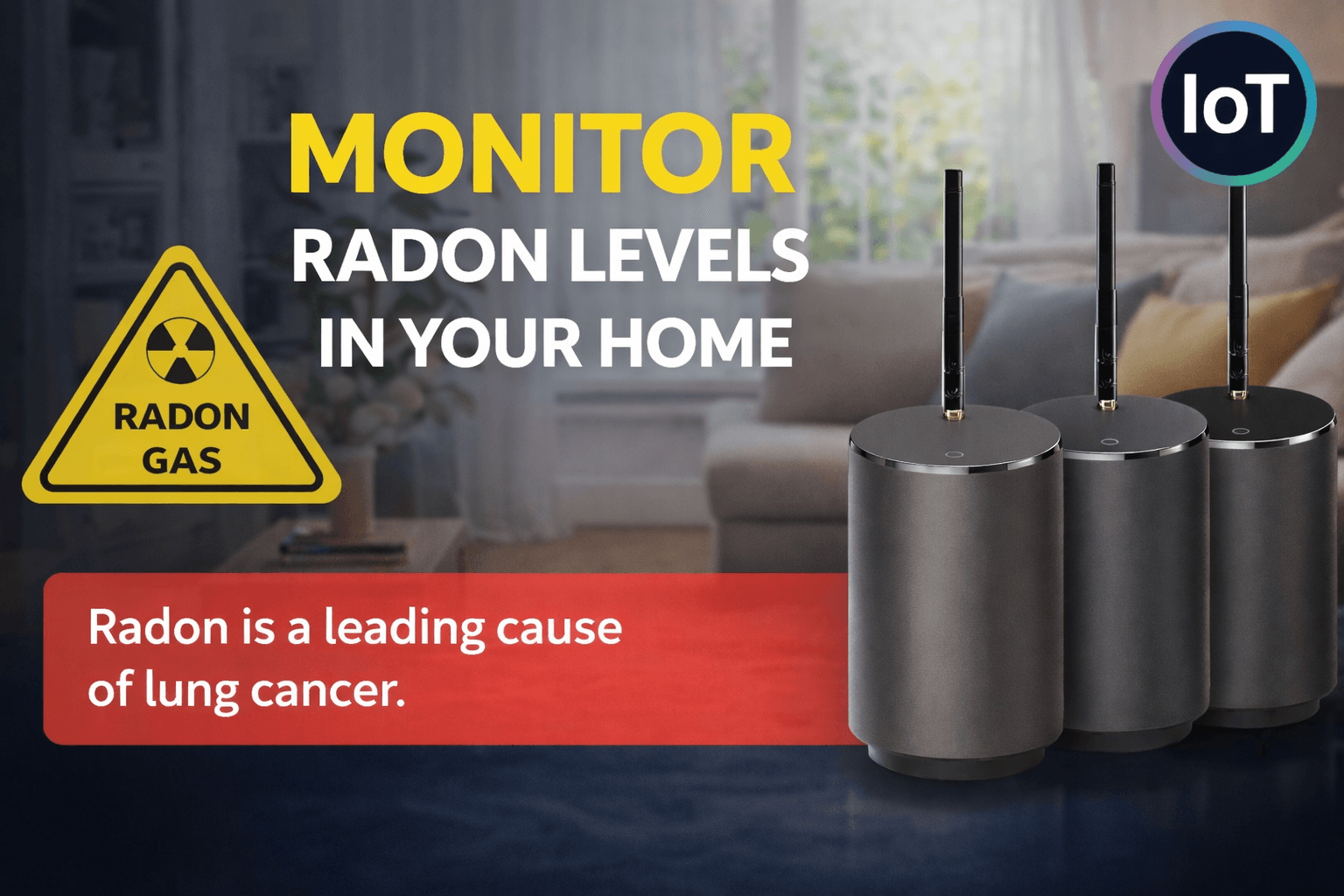
Radon-Only Sensor — a dedicated radon monitor for environments where only radon concentration tracking is needed. Ideal for residential basements, crawl spaces, and single-purpose monitoring.
Multi-Sensor (Radon + Indoor Air Quality) — a comprehensive monitor that tracks radon levels alongside temperature, humidity, and CO₂ concentration (ppm). Ideal for schools, offices, healthcare facilities, and any environment where overall indoor air quality matters alongside radon safety.
Both versions deliver:
- First reading in just 10 minutes
- Reliable results within 1 hour
- Industry-leading radon counting sensitivity of 30 CPH (Counts Per Hour)
- Hourly measurement updates transmitted via LoRaWAN
- Radon levels reported in Becquerels (Bq)
Sensors connect wirelessly via LoRaWAN to the EdgeKinect Vision cloud platform, transmitting data automatically with no manual intervention.
The system automatically captures:
- Current radon levels across all monitored locations
- Threshold exceedances with timestamped alerts
- Historical trends to identify seasonal patterns and high-risk periods
- Before-and-after data to validate mitigation system performance
- Indoor air quality context (temperature, humidity, CO₂) where multi-sensors are deployed
No manual testing cycles. No lab wait times. No gaps in visibility.
The Result
After deployment, building operators gained immediate and continuous visibility into radon conditions — replacing guesswork with verified data.
Key outcomes included:
- Dangerous radon spikes were detected and addressed in real time, not months later
- Mitigation systems were validated with continuous before-and-after monitoring data
- Buildings previously assumed to be safe were identified as needing attention
- Seasonal radon patterns were mapped, enabling proactive ventilation adjustments
- Compliance reporting became automated and evidence-based
In schools equipped with multi-sensors, administrators gained a complete picture of indoor air quality — not just radon, but also CO₂ levels that affect student concentration and comfort — allowing them to demonstrate to parents and staff that their learning environments were being actively monitored and managed.
Why This Worked
The success came from replacing episodic, manual testing with continuous, automated monitoring.
Organizations gained:
- Always-on awareness of radon conditions across their entire building portfolio
- Immediate detection of threshold exceedances — not after weeks of waiting
- Data-driven proof that mitigation investments were delivering results
- Scalable monitoring without proportional increases in staff or cost
- Simple deployment with no complex networking or infrastructure changes
Instead of discovering radon problems after prolonged exposure, teams could act before occupants were at risk.
The Technology Behind the Success
The solution worked because it combined precision sensing with long-range wireless connectivity and a cloud dashboard:
LoRaWAN Radon Sensors (Two Versions):
- Radon-Only: dedicated radon concentration monitoring
- Multi-Sensor: radon + temperature + humidity + CO₂ (ppm)
- First reading in 10 minutes, reliable results within 1 hour
- Industry-leading sensitivity of 30 CPH (Counts Per Hour)
- Hourly updates transmitted wirelessly via LoRaWAN
- Radon levels measured in Becquerels (Bq)
- Compact, tamper-resistant, wall-mountable designs
- Long battery life with no lab processing required
LoRaWAN Network:
- Long-range, low-power wireless communication
- Reliable indoor coverage — even in basements and below-grade spaces
- No Wi-Fi dependency or complex network configuration
- Scalable from single buildings to campus-wide deployments
EdgeKinect Vision Dashboard:
- Real-time dashboards with building-level and room-level views
- Interactive maps and floor plans showing sensor locations
- Configurable alert rules via email, SMS, and dashboard notifications
- Historical trend analysis and automated reporting
- Mobile-friendly access for facility managers on the go
Impact
This deployment delivered measurable improvements in:
- Occupant health protection through early detection and rapid response
- Mitigation system accountability with continuous performance verification
- Regulatory compliance and due diligence documentation
- Operational efficiency — monitoring at scale without manual testing cycles
- Stakeholder confidence through transparent, data-backed reporting
Most importantly, it transformed radon management from a periodic, reactive testing exercise into a continuous, proactive safety program — ensuring that the invisible threat of radon was always visible to the people responsible for building safety.
Ready to Monitor Radon Continuously?
Our IoT Radon Monitoring solution provides real-time visibility, automated alerts, and actionable intelligence — helping property managers, school boards, and building operators protect occupants from Canada's invisible health threat.