Blog

Why Private 5G Is Emerging as the Foundation of Industrial IoT

Private 5G networks are rapidly becoming the backbone of industrial IoT deployments, offering ultra-reliable, low-latency connectivity and enhanced security. Discover how manufacturers, utilities, and logistics providers are leveraging private 5G alongside LoRaWAN and edge computing for next-generation automation.
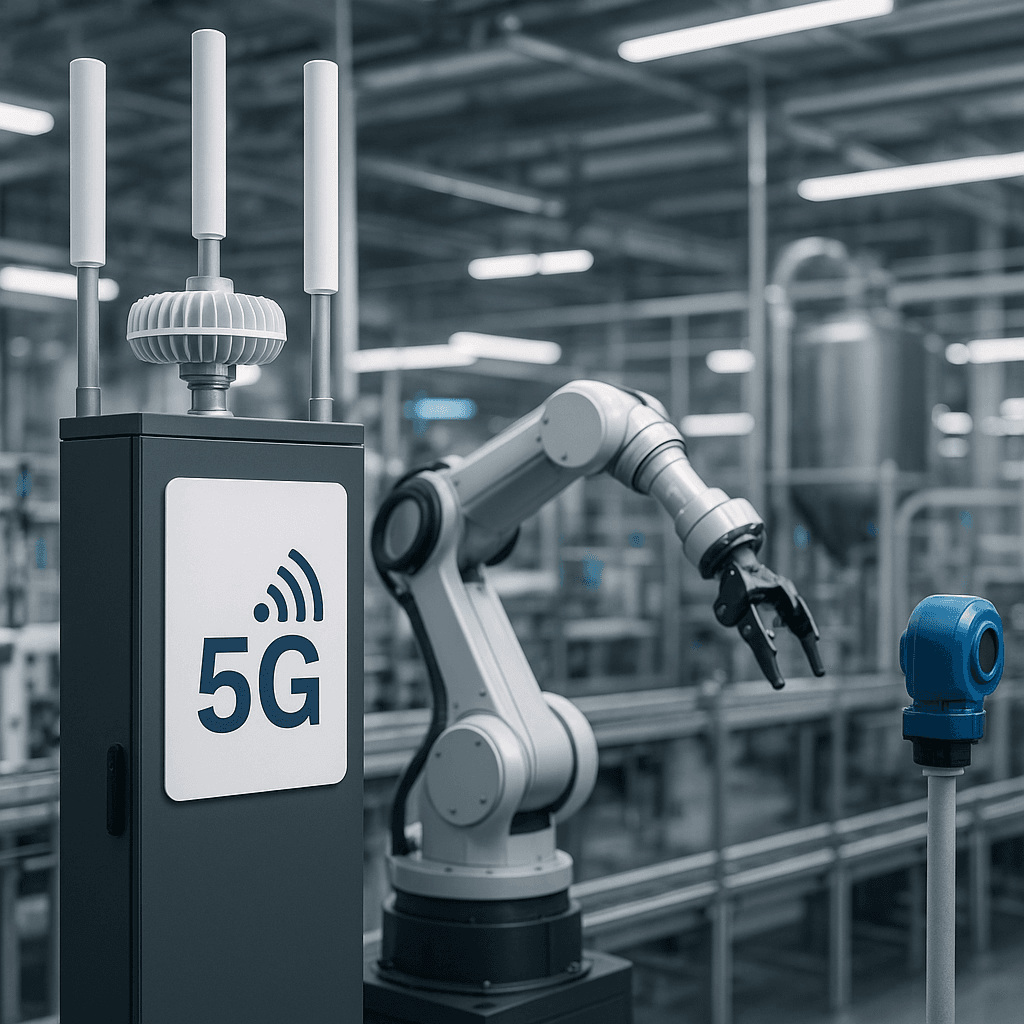
Private 5G network infrastructure supporting industrial IoT devices in a smart factory | AI-generated image
Published at

Private 5G is no longer a future concept—it’s quickly becoming the digital backbone of modern industrial operations. As factories, utilities, and logistics hubs accelerate automation, they need connectivity that is ultra-reliable, low latency, and fully under their control. Public networks alone can’t always meet those demands, which is why private 5G is gaining serious momentum in Industrial IoT (IIoT) deployments.

The Industrial Connectivity Challenge

Industrial environments are complex. They combine:

  • High device density (thousands of sensors and machines)
  • Mission-critical operations requiring near-zero downtime
  • Harsh physical conditions (metal interference, remote sites, underground facilities)
  • Strict data security and compliance requirements

According to industry estimates, over 75% of industrial data is expected to be processed at the edge by 2027. That shift requires fast, deterministic connectivity within facilities—something traditional Wi-Fi and even some public cellular networks struggle to guarantee.

Private 5G addresses these challenges by offering dedicated spectrum, localized control, and performance engineered specifically for operational technology (OT) environments.

What Makes Private 5G Different?

Unlike public cellular networks shared across millions of users, private 5G networks are deployed for a single organization or site. That exclusivity unlocks several critical advantages:

Ultra-Low Latency
Private 5G can achieve latency under 10 milliseconds, enabling real-time robotics control, autonomous vehicles, and precision manufacturing.

High Device Density
It supports up to one million devices per square kilometer—ideal for sensor-heavy facilities and smart warehouses.

Network Slicing & QoS Control
Critical systems (like safety controls) can be prioritized over less time-sensitive traffic such as environmental monitoring.

Enhanced Security
Data remains within the enterprise-controlled infrastructure, reducing exposure to external threats.

For industries like automotive manufacturing, mining, oil & gas, and ports, these capabilities are game-changing.

Real-World Use Cases Gaining Momentum

Private 5G is already being deployed in high-value industrial scenarios:

  1. Smart Manufacturing
    Automotive plants are using private 5G to connect robotic assembly lines, automated guided vehicles (AGVs), and quality inspection cameras.

  2. Energy & Utilities
    Power generation facilities leverage private networks to connect substations, enable predictive maintenance, and support remote monitoring.

  3. Logistics & Ports
    Major global ports are deploying private 5G to coordinate cranes, autonomous trucks, and container tracking systems with minimal latency.

In many of these cases, private 5G works alongside other technologies. For example, LoRaWAN may handle long-range, low-power sensor data across large sites, while 5G manages high-bandwidth applications like video analytics.

The Role of Edge Computing in 5G Deployments

Connectivity alone isn’t enough. Industrial environments generate massive amounts of data—especially when AI-driven machine vision and predictive analytics are involved.

That’s where edge computing platforms such as EdgeKinect Core and EdgeKinect Vision play a vital role.

  • EdgeKinect Core enables secure, on-site data processing, reducing cloud dependency and lowering response times.
  • EdgeKinect Vision supports AI-powered video analytics for quality control, worker safety, and asset monitoring.

When paired with private 5G, these platforms create a powerful architecture:

Private 5G → Edge Processing → Cloud Insights

This hybrid approach ensures immediate operational decisions happen locally, while long-term analytics and optimization occur in the cloud.

Private 5G vs. LoRaWAN vs. Multi-Provider IoT SIMs

It’s important to note: private 5G isn’t a replacement for every connectivity solution.

At IoTKinect, we see industrial customers adopting a multi-layered connectivity strategy:

  • LoRaWAN for low-power, long-range sensors (tank levels, environmental monitoring, smart metering)
  • Multi-provider IoT SIM cards for mobile or geographically distributed assets
  • Private 5G for high-speed, mission-critical operations inside facilities

The future of IIoT isn’t about choosing one network—it’s about designing the right architecture for each use case.

The Road Ahead for Industrial IoT

As Industry 4.0 matures, private 5G is moving from pilot projects to full-scale deployments. Analysts predict that the number of private 5G networks worldwide will grow exponentially over the next five years, particularly in manufacturing and energy sectors.

Organizations that invest early are seeing measurable results:

  • Reduced downtime through predictive maintenance
  • Increased production efficiency via automation
  • Improved worker safety with real-time monitoring
  • Greater control over data sovereignty and cybersecurity

Private 5G is not just about faster connectivity—it’s about enabling smarter, safer, and more autonomous operations.

For industrial leaders building the next generation of connected infrastructure, it’s quickly becoming the backbone of digital transformation.

Contact Us | Explore Solutions

More Blog Posts

Start Your IoT Journey

Ready to Transform Your Business?

Join hundreds of companies leveraging IoT to drive innovation and growth.