

Vape detection without a camera in the building.
We plan the coverage, install the sensors, run the dashboard and route the alerts. You are told which sensor fired, and when — without a camera or microphone anywhere in the building.
- Cameras or microphones
- 0
- Vape index, threshold set per sensor
- 0–100
- Sensors in a typical secondary school
- 8–30
- LoRaWAN gateway per campus, usually
- 1
The problem
352,000
students in grades 7 to 12 vaped in the past 30 days
That is 17% of Canadian students, and 24% of those in grades 10 to 12. Four in five got the device from a friend or family member, and 63% were vaping a fruit flavour.
Schools are expected to stop this in the one room they are not allowed to watch.
Source: Health Canada, Canadian Student Tobacco, Alcohol and Drugs Survey, 2021-22
It measures the air, not the room.
An e-cigarette burns nothing, so a smoke alarm never sees it. The GS601 reads what the aerosol leaves behind and cross-references four signals, so a hot shower does not read as an incident.
- Particulates, TVOC, temperature, humidity and vibration sampled together
- Fused into one vape index from 0 to 100 that you set a threshold against
- Resistant to water vapour, steam and aerosol sprays
- Sensitivity tuned per sensor from the dashboard
PM2.5
µg/m³
TVOC
µg/m³
Humidity
% RH
Vape index
0–100
Shower steam
No alert
Vape
Alert sent
Milesight GS601.
We standardised on this unit because it fuses enough signals to stay quiet in a humid washroom. One ceiling-mounted device, 128 mm across, drawing 5 V over USB-C.
- Vape pens, disposables and pod systems; cigarettes; cannabis, vaped or smoked
- PM1.0, PM2.5, PM10, TVOC, temperature and humidity
- Flame alarm watches 20 °C to 60 °C; a vibration sensor catches covering and removal
- Buzzer hibernate: silence the siren from the dashboard, keep the log


Where it goes
Rooms nobody can watch.
Coverage is counted in rooms, not square feet. Most secondary schools land between 8 and 30 sensors, all reporting through a single gateway.
Washrooms
Where the problem concentrates, and where cameras are illegal
Classrooms
Occupied rooms where air quality matters anyway
Stairwells
Low-traffic corners that no supervision rota reaches
Residences
Student housing, hotels and short-term rentals


What we run
Monitoring, not hardware.
A sensor on its own transmits packets. Monitoring means someone planned the coverage, commissioned the network, made the data readable and answers the phone when a unit goes quiet. We build the platform ourselves, so every layer answers to the same number.
01
Sensor
A GS601 per washroom, locker room, change room or stairwell. Ceiling mounted, USB-C or PoE, configured by phone over NFC.
02
Gateway
One LoRaWAN gateway usually covers a whole campus. Long range, low power, no cabling run to each sensor.
03
Platform
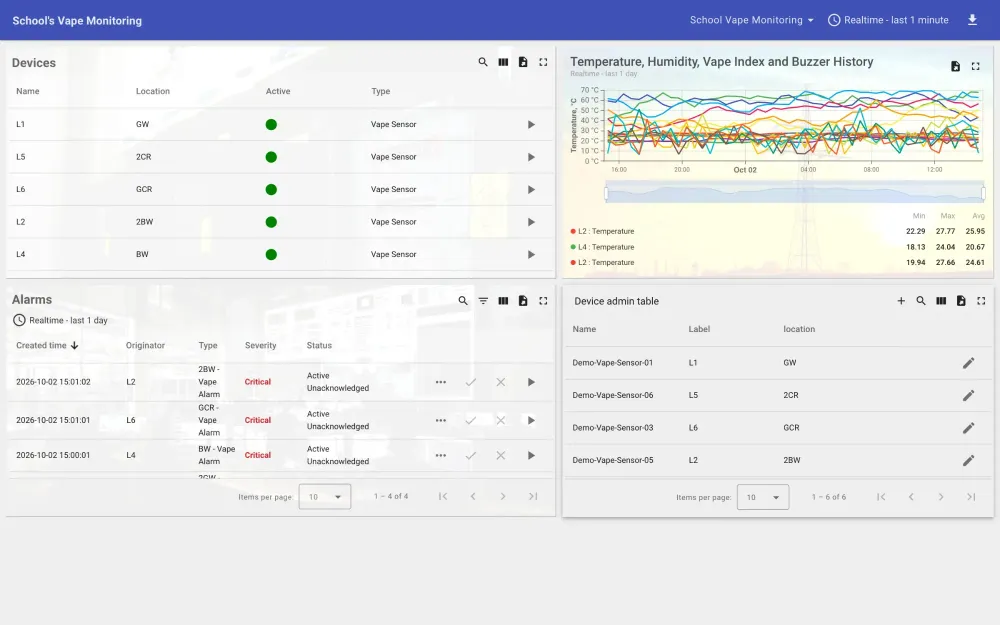
Our dashboard turns payloads into named sensors and readable incidents — vape, smoke, tamper, heat — and controls the fleet remotely.
04
Alert
Routed per sensor to the people you nominate, over dashboard, email, SMS or webhook.
Privacy
No camera. No microphone.
Vape detection is only useful where the vaping happens — exactly where video and audio surveillance is prohibited: under FERPA and state law in the United States, and under PIPEDA and provincial legislation such as BC's FIPPA in Canada. The GS601 measures particulates, volatile organic compounds, temperature, humidity and vibration. That is the entire list.
- No camera
- No image is captured, stored or transmitted.
- No microphone
- No audio is recorded or analysed.
- No identification
- A sensor reports its own reading and a timestamp, never a person.
- No cloud lock-in
- Incident history stays in the platform you control.
Privacy legislation varies by jurisdiction. Confirm your obligations with your own counsel or privacy officer before deployment.
Specifications
GS601 specifications.
Milesight's published datasheet values. Ask us for the current datasheet and the regional frequency plan for your site.
Detection
- Vape index
- Laser scattering · 0–100 range · ±10 accuracy · resolution 1
- Nicotine & cigarette smoke
- Cigarettes and other burnt nicotine products
- Cannabis / THC
- Both vaped and smoked signatures
- TVOC
- MOX (MEMS) · 0–2000 µg/m³ · ±15% of reading (1–500 µg/m³)
- PM1.0 / PM2.5
- Laser scattering · 0–1000 µg/m³ · ±10 µg/m³ (0–100 µg/m³)
- PM10
- Laser scattering · 0–1000 µg/m³ · ±25 µg/m³ (0–100 µg/m³)
- Interference rejection
- Resistant to water vapour, steam and aerosol sprays
Environmental sensing
- Temperature
- Digital CMOSens® (MEMS) · −20 °C to 60 °C · ±0.2 °C · 0.1 °C resolution
- Humidity
- Digital CMOSens® (MEMS) · 0–100% RH · ±2% RH · 0.5% RH resolution
- Flame / heat alarm
- Monitors 20 °C – 60 °C for early fire and arson indicators
- Tamper detection
- Built-in vibration sensor for covering, removal or impact
LoRaWAN® wireless
- Protocol
- LoRaWAN® · OTAA / ABP · Class C
- Frequency bands
- RU864 · IN865 · EU868 · US915 · AU915 · KR920 · AS923-1/2/3/4
- Antenna
- Internal
- TX power
- 16 dBm (868 MHz) · 22 dBm (915 MHz)
- Sensitivity
- −137 dBm @ 300 bps
On-device alerting & setup
- Buzzer
- 70 dB @ 1 m, with configurable hibernation to suppress false alarms
- Indicators
- 1 × status / alarm LED · 1 × buzzer
- Controls
- 1 × external reset button
- Configuration
- Mobile app over NFC, or LoRaWAN downlink
- Advanced features
- Threshold alarms, tamper alarm, calibration, FUOTA
Physical & power
- Power supply
- 5 V / 1 A via USB Type-C, or optional PoE splitter
- Operating temperature
- −5 °C to 45 °C
- Operating humidity
- 0–95% RH, non-condensing
- Ingress protection
- IP30
- Dimensions
- Ø 128 × 40 mm (Ø 5.04 × 1.57 in)
- Weight
- 178.6 g
- Mounting
- Ceiling or wall mount
- Colour
- White
Approvals
- Regulatory
- CE · FCC
- Environmental
- RoHS
Figures are Milesight's published datasheet values and may change without notice.
FAQ
Frequently asked questions
Still working out how many sensors your building needs?
A vape detector continuously samples the air for the signature an e-cigarette aerosol leaves behind. The GS601 combines laser-scattering particulate readings (PM1.0, PM2.5, PM10), a metal-oxide TVOC sensor, and temperature and humidity readings, then fuses them into a single vape index from 0 to 100. When that index crosses your threshold, the sensor raises an alert over LoRaWAN and can sound its on-board buzzer. Because it is measuring air chemistry rather than recording a room, it works in bathrooms and locker rooms where cameras and microphones are not permitted.
Talk to us
Tell us how many washrooms you have.
From a room count and a floor plan we size the gateway, quote the sensors and show you the dashboard your staff would use — before you commit to anything.
- Sales
- (778) 900-5895
- [email protected]
- Hours
- Mon–Fri, 08:30 AM – 04:30 PM PST