

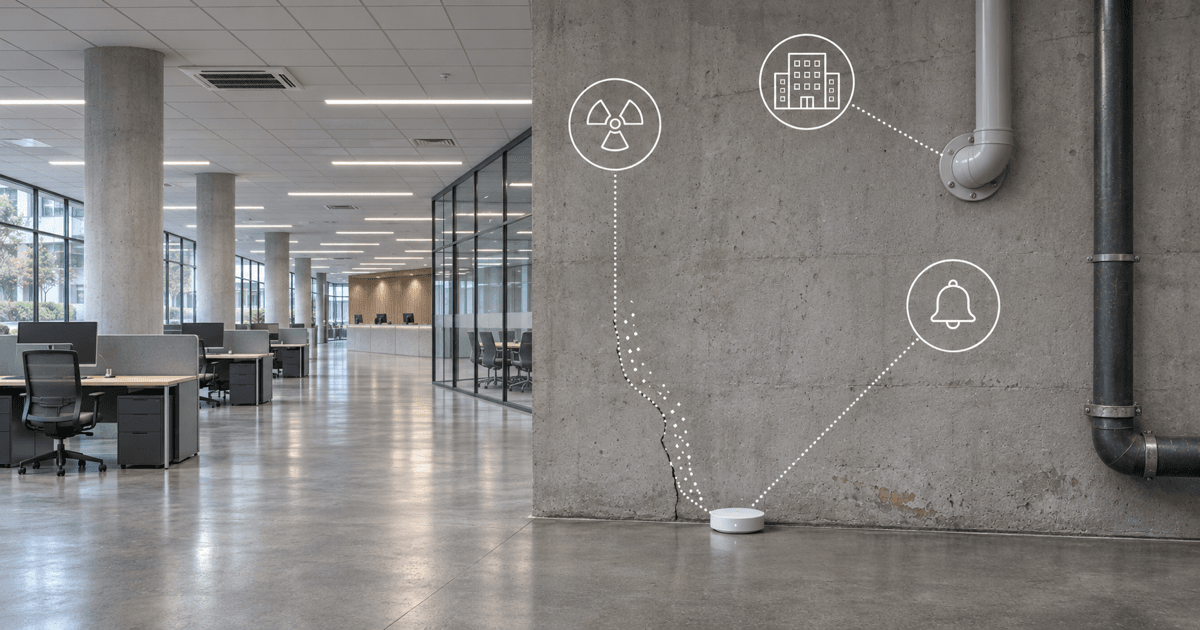
Radon is a gas you can't see, smell, or taste, and it could be in the building you're in right now.
It's found in every region of Canada, and it's the leading cause of lung cancer in people who have never smoked.
November is Radon Action Month. Whether you own a home, rent an apartment, or manage an office building, here's what radon is, how it affects your health, and how to find out how much is in your building.
What Is Radon?
Radon is a natural gas that comes from the ground. It forms when uranium, a metal found in small amounts in soil and rock everywhere, slowly breaks down over time.
Radon is radioactive. That means it gives off tiny bursts of energy, called radiation, as it breaks down. You can't feel it happening, but over many years that energy can damage the cells in your body.
Outdoors, radon mixes with fresh air and stays at very low levels. The problem starts indoors, where radon can get trapped and build up.
How Radon Gets Inside
Radon can get into any building that touches the ground: houses, schools, offices, and banks alike. It moves up through the soil and slips in through openings such as:
- Cracks in foundations and concrete floors
- Gaps around pipes, drains, and cables
- Open spots like sump pits (holes in some basement floors that collect water) and crawl spaces (the shallow space under some buildings)
Spaces below ground level, such as basements, parkades, and bank vaults, sit closest to the source. Radon levels also change from season to season. They're often highest in winter, when windows stay shut and buildings are sealed tight.
Some parts of Canada have higher levels than others. Saskatchewan, Manitoba, New Brunswick, and Yukon have radon levels comparable to some of the highest in the world. You can see the share of homes with high radon in your area on the Public Health Agency of Canada's radon map.
Still, two buildings side by side can have very different radon levels, and so can rooms in the same building. The only way to know your level is to test.
How Radon Affects Your Health
When you breathe in radon, it gives off radiation inside your lungs. Over years, this can damage the cells that line your lungs and lead to lung cancer.
- Radon is the #1 cause of lung cancer in non-smokers, and the second-leading cause overall, after smoking.
- It's linked to more than 3,000 lung cancer deaths in Canada every year.
- For people who smoke, high radon levels raise the risk even further.
Radon doesn't cause symptoms like coughing or headaches. You won't feel sick from it, which is why many people don't know they're being exposed.
How Much Radon Is Too Much?
Radon is measured in becquerels per cubic metre (Bq/m³). It sounds technical, but the idea is simple:
Becquerel (Bq) — counts radioactive activity. One becquerel means one radon atom breaking down every second.
Cubic metre (m³) — a box of air one metre long, one metre wide, and one metre high.
So a reading of 200 Bq/m³ means that in every cubic metre of air, about 200 radon atoms break down each second. For comparison, outdoor air usually has about 15 Bq/m³.
Health Canada's guideline is 200 Bq/m³. If your building tests above that, Health Canada recommends taking steps to lower it. No level of radon is completely safe, so lower is always better.
Radon at Home and at Work
Most radon advice is written for homeowners, but radon isn't only a home issue. Many of us spend about a third of each day at work or school, often in buildings that sit on the same ground.
At home — basements and ground-floor rooms usually have the highest levels.
At work — offices, bank branches, and buildings with underground floors or parkades can all collect radon.
For building owners and employers — testing is part of keeping people safe. Health Canada has a guide for measuring radon in public buildings, including workplaces, schools, and care facilities.
How to Test for Radon
There are two main ways to measure radon.
| Long-term test | Continuous monitoring | |
|---|---|---|
| How it works | A small detector stays in place for at least 3 months, then goes to a lab | A connected sensor measures radon all the time and sends the readings online |
| What you get | One average number for the test period | Up-to-date readings, trends over time, and alerts |
| Best for | A first check of a home or small space | Large buildings, multiple sites, and making sure a fix keeps working |
Health Canada recommends testing for at least 3 months, ideally in fall or winter. A long-term test gives you a reliable average. Continuous monitoring shows you more: when levels rise, which rooms or floors are worst, and whether levels stay low after a fix.
If your levels are high, the fix is called radon mitigation. A certified professional, usually one certified by the Canadian National Radon Proficiency Program (C-NRPP), can lower radon, most often with a method called active soil depressurization, which vents radon out from under the building and can cut levels by about 90%. IoTKinect can help you source a certified mitigation service.
How IoTKinect Helps
At IoTKinect, we set up continuous radon monitoring, so you know your levels every day, not just once every few months.
The sensor — we offer two radon monitors, and both measure around the clock. The radonIQ plugs in and is the usual choice for buildings, with its first reading in about 10 minutes. The radonIQ Pro runs on batteries, for spots with no power outlet. You choose how often they send a new reading.
The network — it sends data over LoRaWAN, a wireless network built for sensors. It carries small amounts of data over long distances using very little power, and it doesn't need your building's Wi-Fi.
The dashboard — your readings show up in EdgeKinect Vision, our easy-to-read online dashboard. You choose when to get an alert, for example when a room passes 200 Bq/m³, or earlier as a warning.
One view for many buildings — keep an eye on one building or a whole portfolio of sites from a single screen.
Sensor → LoRaWAN network → EdgeKinect Vision → Alert to your team
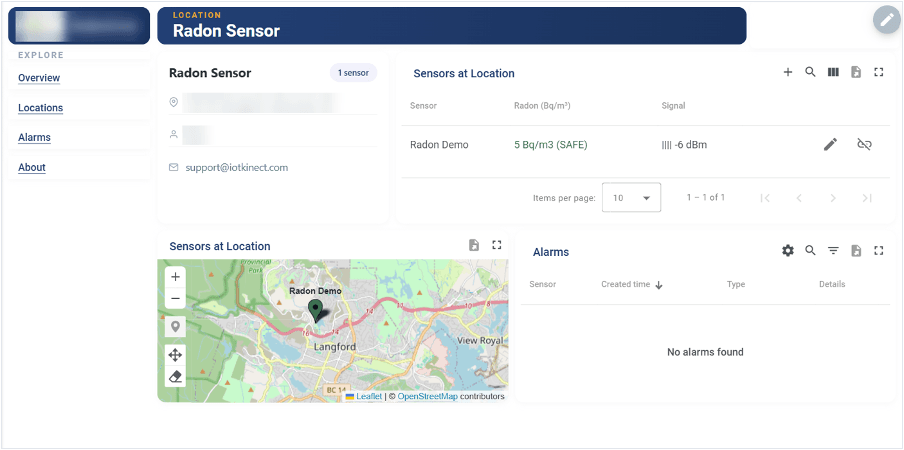
EdgeKinect Vision shows each location's sensors, their latest readings and any alarms on one screen. Client details are hidden.
Want to see it in action? Read how it works in our continuous radon monitoring use case.
Ready to Find Out What's in Your Air?
This Radon Action Month, take the first step and test. Whether you manage one building or a dozen, we can help you measure radon and stay on top of it.